" /> BI Questions Blog: July 2007 Archives

« June 2007 | Main | August 2007 »

July 29, 2007

Free-Wheeling Business Intelligence?


Later today, the Tour de France will be rolling into Paris to complete the final leg on the Champs-Elysées, so it seemed a good time to share this story of business intelligence and bicycles.

The city of Paris recently rolled out their latest big initiative in making Paris a more livable, green city: 10,000 bicycles, distributed across 750 "stations" across Paris, as part of a program called "Velib" -- from "vélo" (bicycle) and "liberté" (freedom).

The bicycles are designed for city use -- solid, but comfortable, easy to adjust, and supplied with a basket, lights, and lock. To take a bike, you just swipe your credit card, grab a bike from one of the locked stands, and return it any station in the network. The prices are very reasonable: 1 euro for a day pass, 5 for a week, and just 29 euros for the year (I'm personally a huge fan already, and I'm eagerly awaiting my yearly pass).

The city doesn't actually run the program, they outsource it to JC Decaux, a big outdoor advertising specialist, in exchange for an exclusive contract for the city's advertising billboards. And JC Decaux is a big user of BI software, using it to analyze the profitability of different advertising placement strategies.

The Velib project has been an unqualified success, with over 150,000 users in the first four days. JC Decaux's operational systems provide real-time information, so that you can go to the web site and click on a station to find out how many bikes are available (although unfortunately it's not yet easy to get the map to appear on a mobile phone, where it would be the most useful).

BI is going to be key to the optimal running of the organization (and presumably to whether JC Decaux can make their desired profit on the service).

One example is keeping maintenance costs down -- the bicycles have to be serviced on a regular basis -- there have some teething problems with the stations themselves. In the first week or so,  to 5% of the stations have had some sort of problem, including occasions when users returned their bicycles, but the station refused to register the return, and continued to charge usage fees.

Another big problem is going to be optimizing the usage: currently, at any given time of the day, some of the stations have no bicycles, and some are full (so you can't return a bicycle to that stand, and have to find another one -- from personal experience, this is very annoying..).

There are teams of trucks that move bicycles around Paris to make sure they're in the right places -- but as you can imagine, this is an incredibly complex operation to optimize, since it's based on the time of the year, the weather, the state of traffic, whether the Tour de France is in town, etc.

I believe this is currently being done in a relatively manual, operational way (i.e. when the stand is empty, move bicycles to it), but BI will be the key to optimizing the system, with proactive distribution in advance of problems, rather than after the fact. After a solid history has been built up over time, JC Decaux should be able quickly react to any differences between planned and actual operations. Disneyland Paris have already taken a similar approach, with great success.

The Velib project has been so successful that the number of bicycles and stations is set to double in the next few years (and extended to the near suburbs), and other cities -- notably London -- are strongly thinking of following Paris's lead.

Photo Credits:
http://www.flickr.com/photos/malias/821755467/
http://www.flickr.com/photos/luc/917511203/

July 16, 2007

What Executives Want from BI?

Joe McKendrick recently posted on the ongoing difficulties faced by companies trying to use business intelligence effectively, especially for executive users:

Many of today's BI solutions, in fact, 'have only exacerbated the amount of information that is bombarding senior management and left it up to them to decipher, collate and try to find the nuggets of useful and relevant information for their particular responsibility.'

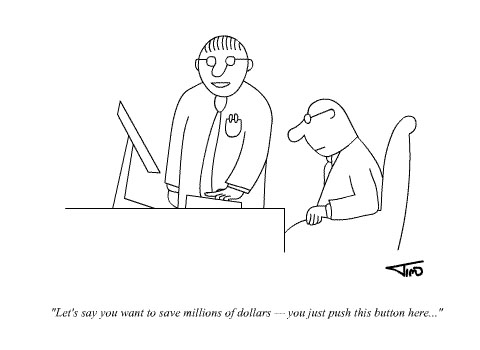
What executives really want is shown below -- although I suspect it might take a while...

press this button

And as for this comment from the same posting, see previous cartoon here.

"Sometimes one wonders if working more on gut feel back in the good ol' days was easier and more effective."

July 12, 2007

Structured, Unstructured and Pureplay BI

Business Objects closed its Inxight acquisition earlier this week. Structured and unstructured analysis coming together makes it harder to claim that any single database or application standard stores all of the data that needs to be analyzed. 

standardized

July 02, 2007

BI Briefs: UPS, Facebook, MySQL, SAP, Microsoft

UPS minimizes left-turns. Advanced route planning minimizes fuel consumption and accidents. An old story, but given new life with a recent InformationWeek interview with UPS CIO Dave Barnes (and a good example of delivering effectively on a strategic multi-year IT project).

Facebook's community app platform. As BI vendors try to web-2.0 themselves, they will need to create communities -- will they start turning to new platforms, such as Facebook's? From the look at the applications available so far, no -- but over 25s are their fastest-growing segment, and there's at least some interest in the enterprise space: "interesting... harder to build than consumer... maybe ability to better integrate applications some down the line". Disclosure: I only signed up two weeks ago...

MySQL going public? How much is open-source worth in the BI space? This will presumably be eagerly watched by open-source BI vendors such as Pentaho. I'm a big fan of iStockPhoto for cheap, royalty-free images for presentations, and it turns out that they use Pentaho and MySQL.

SAP's Performance Management Blog. Nenshad Bardoliwalla was at Hyperion before joining SAP. His blog gives insight into how the acquisition of Outlooksoft fits into SAP's strategy (with link to SAP's CPM presentation in May), and talks about Pilot's web 2.0 approach to strategy (see previous posting.)  And some inevitable Oracle/Hyperion bashing.

Microsoft PerformancePoint a tough sell? Stephen Sawyer writes that Office, Excel and confusion shaping up as PerformancePoint Server’s biggest competition.